
“A rival gets recommended daily and we’d never know.”
Peakmark records the brands named in your category’s answers, including ones you didn’t list, and alerts you when a new competitor appears.
Every AI answer in your category names someone. Peakmark shows who: share of voice, per-prompt visibility and sentiment, engine by engine.
The free check needs no account · Plans from $79/month
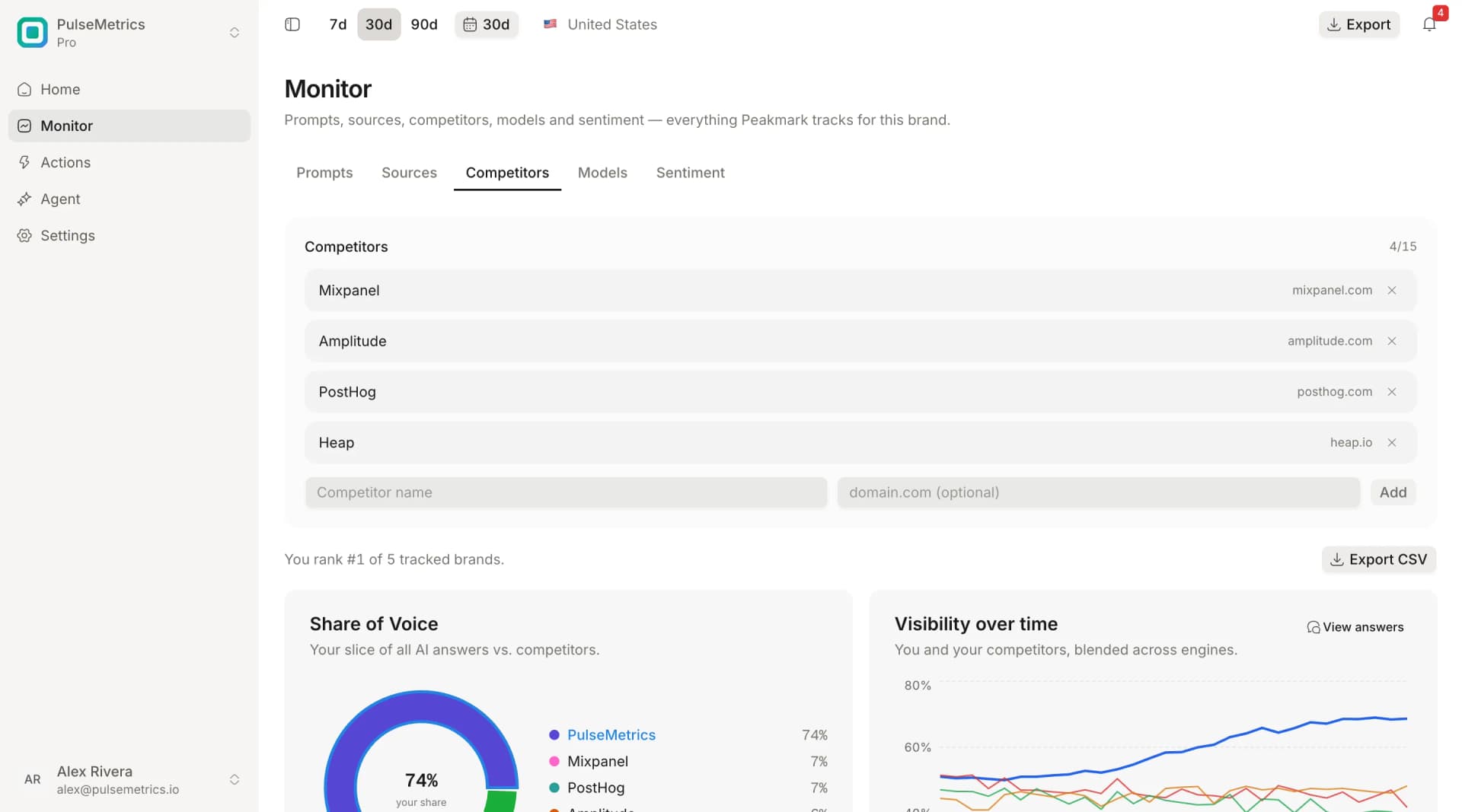
Peakmark records the brands named in your category’s answers, including ones you didn’t list, and alerts you when a new competitor appears.
AI answers lean on reviews, forums and comparison articles, so their shortlist can differ from a search results page. We show the competitors AI actually names.
One share-of-voice number, trended over time. A screenshot answers the question.
Who gets named, how often, in what order, and with what tone.
Your mentions as a share of all brand mentions across your tracked prompts: a clean “are we winning?” number for AI answers.
Every tracked prompt has its own visibility score, so you can sort the list and find the questions where competitors get named and you don’t.
Peakmark records the brands the engines name in their answers, including challengers you weren’t watching. You can add or remove rivals yourself.
Mentioned isn’t enough: “popular but pricey” loses deals. Compare how the engines describe you against each rival.
4.4×
the value of an AI-search visitor vs. an organic one, by conversion rate
Semrush study, 2025
Start from the auto-detected set, add anyone we missed and remove anyone who isn’t a real rival.
Every answer is scored for every brand it names, yours and theirs, on all four engines.
Open a prompt you’re losing and check which sources the answers cite. Then generate an action for it, or ask the agent to draft a page or an outreach pitch. You review and ship.
Monitoring, evidence and actions: every piece feeds the next.
Share of voice, gaps and sentiment on four engines, checked every day.
Get started